

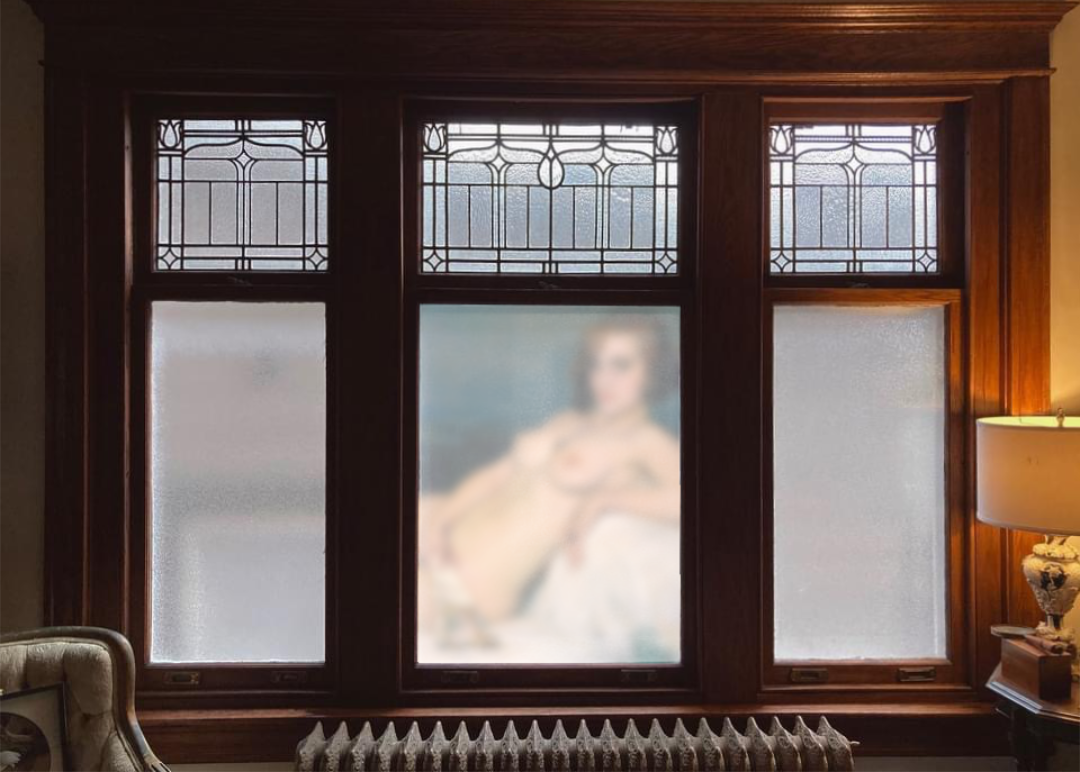
There is an absolutely stunning triptych window in our dining room original to the 1910 house. It dominates all but a sliver of the southern wall and features elegant leaded glass upper sashes hung above oversized lower sashes that nest up into the wall to fully open.
Their function is mesmerizingly clever and all to improve the transparency of the windows, allow in more light with larger sheets of glass. And yet, that very transparency and openness exposes too much, too readily, too willingly to onlookers. The effect is something like standing in the middle of a stage long after the curtain has fallen — the scene bare, the house lights up, and you suddenly aware of how exposed every detail is to whoever cares to look.
The windows, as originally crafted, always looked awkward with curtains or draperies, as if such things were an unfortunate afterthought, a spoiling of the purity of their design. Their wide frames and generous proportions seem to resist the very idea of concealment. Eventually, for the sake of some modicum of privacy, we settled on a vinyl window film that matched one of the crinkle glass textures in the upper sash.
And with this simple addition, everything suddenly seemed right. We dramatically increased the opacity of the window, improved our privacy without diminishing the amount of natural light, and it seemed as if it were an original feature. What astonished me most was how little the light changed — how it still filled the room, but now in a softened, more forgiving way. The sharp outlines of the outside world blurred just enough to feel distant without vanishing entirely.
The house buyers in 1910 probably loved the novel post-Victorian idea of big open windows and lots of natural light right up until they had to deal with the complete lack of privacy and then solved it by throwing up big, thick draperies that hid the very architecture on which they’d spent so many resources. One imagines the conversation: the thrill of openness meeting the day-to-day discomfort of feeling observed, and the reluctant acceptance that beauty sometimes has to be dimmed for the sake of comfort.
Not unlike them, I came of age at the peak of that moment in the early aughts when we were actively choosing to be radically honest, radically open, and radically sincere — exposing ours souls behind the most transparent and revealing glass. The idea was intoxicating: that all the old hesitations and polite evasions could be cleared away, replaced by a kind of moral daylight in which everything was equally visible, equally speakable.
We would preside over an age where there were no closets, no locks and keys, no shame and its attendant mendacities. The closets would be flung open, the locked drawers emptied, the private papers read aloud for the betterment of all. We would not shrink from what had once been hidden; we would take pride in our vulnerability, seeing in it the proof of our courage.
And I loved that, I loved the then novel, post-twentieth century ideal that we could be transparent about ourselves, our feelings, our thoughts, all of the underlayments of reality that so many of our forebears had spent so much time and energy and misery concealing. I remember feeling that the air itself seemed fresher in those early years, that friendships were deeper for the things confessed, that love was sturdier when it could withstand the full disclosure of its flaws.
Well, that was then and this is now.
More than twenty years into the new millennium from which people my age took their name and I find myself regularly disappointed and distressed by how much this now long habituated commitment to honesty, openness, and sincerity has become a burden and a liability. The habit of disclosure is hard to break, even when one sees the trap in it — the way a careless truth can be repeated without care for its meaning, the way an unguarded admission can be stored up and returned later as ammunition.
I find myself spinning in circles looking for big, thick draperies to cover my nakedness, a nakedness of self that has since those early, naïve days of idealistic transparency been weaponized against me time and again. What was once a gift offered freely has been taken as a tool to pry further, to test boundaries I no longer wish to keep so permeable. There is a fatigue that comes with constant self-exposure, a sense of always being under review.
I’ve begun to realize, with a certain plaintiveness and disenchantment, the pleasures of opacity and the pains of transparency. And it feels not unlike the very dislocation and destruction of a core identity. To turn away from openness feels almost like betrayal — not only of the creed I once held, but of the self I once believed could thrive in the unfiltered light. Yet there is relief, too, in the thought of a little distance, a little blur, a little space in which to breathe without an audience.
And so I find myself in search of my own version of the window film — something that will allow the light in but soften it, something that will let me see out without letting every passerby see in. I do not wish for darkness. I wish for shelter. For the quiet privacy that keeps a home a home, and a self a self.