

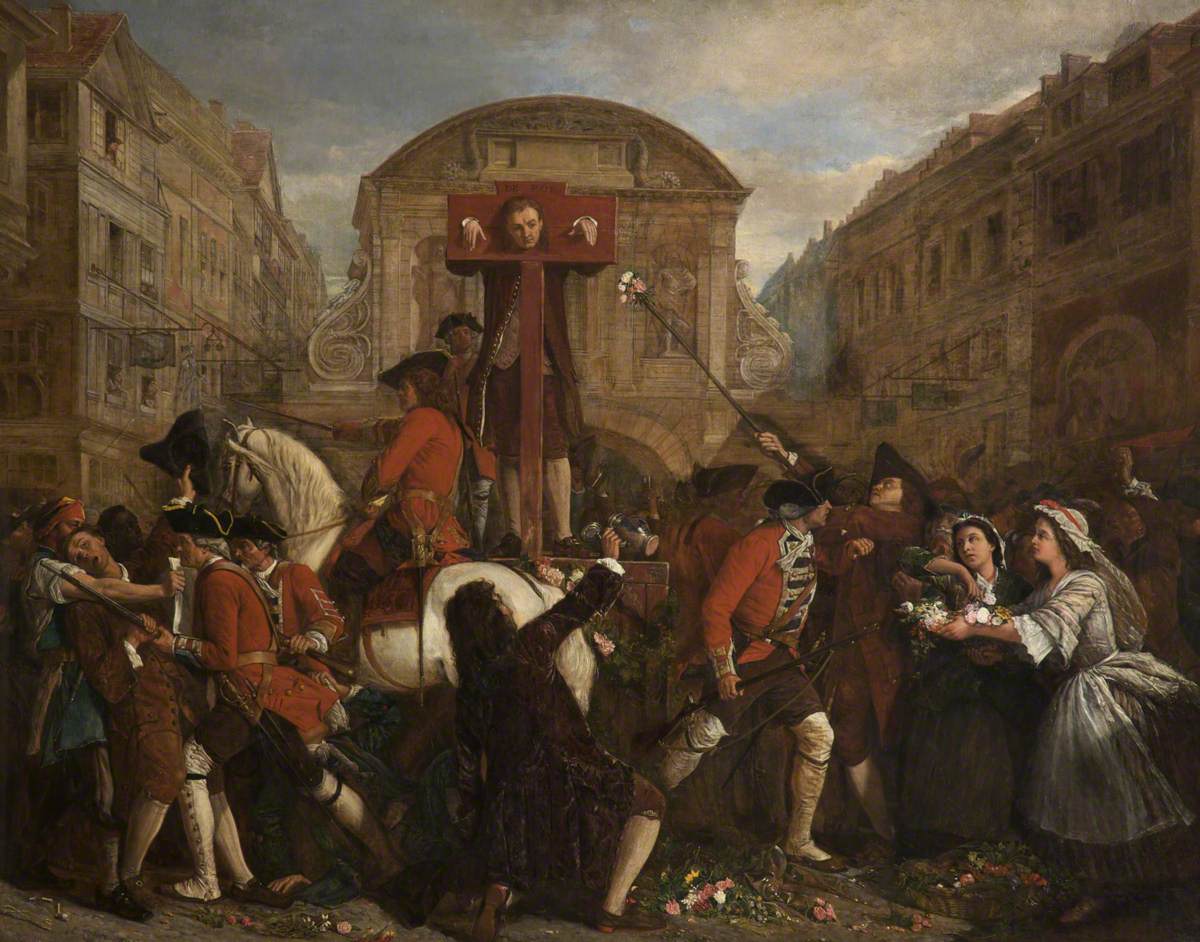
As the rabid political discourses of our ten million petty tyrants and casual sadists reaches a fever pitch — sweating out good and ill alike, wasting and weakening the whole, I find myself wishing that I could return to the closet, to the inner close, to that place of privy things kept privy. I long to permanently retreat back into the shadows with all of the other offscourings of society and, perhaps, have some peace for as long as life lasts.
Is that a craven abdication of responsibility? Is it duplicitous hypocrisy that I write of this longing to hide away in an essay which precludes the possibility, which proceeds to expose what I claim I wish to conceal? Probably, yes. And also, no. All and none of the above. I’ve given up completely on the zealots’ obsessive varnishing over the internally incongruous human soul with their simplistic shells of ideological and moral purity. It’s not only nonsense, I had thought we’d moved past such nonsense. The logic of the limbic system — nevermind the basal ganglia – is a mystery to the articulate mind.
However, I am certainly not alone in wishing to desert from the culture wars, while being drawn continually back to the viscera-spattered front. I am not alone in fearing and loathing and struggling to abandon the internecine carpet-bombing happening within the ranks of what I had long considered my own communities and social alliances, within what was conventionally considered the political left. I am not alone if the hushed worries of so many of my friends and acquaintances, as well as the fate of any who dare to publish their dissent and be lambasted as reprobates by the vanguard elect, is any indication.
If you had told me ten years ago that most of the values and convictions I considered sacrosanct doctrines of a liberal democratic order would now be promiscuously lumped together with the bigoted derangements of the so-called alt-right and neo-fascists, I would have been incredulous. If you had told me that the principles for which I had stood and the ideas to which I held fast would within the decade only be publishable in the pages of Quillette and Areo and Unherd or on vanity-mediums like Substack, side by side with hideous defenses of scientific racism and overt misogyny; their internal Overton windows thrown wide again to include eugenics and sexual essentialism, I would have been skeptical.
But here we are. This is the world in which we find ourselves in the second decade of the twenty first century, the promise of this millennium already squandered, with both left and right regressively radicalizing each other into increasingly restrictive and reductive extremes, fanatical cultists rabbit-holing into an uncompromising mania; either unaware or loudly denying the close kinship and incestuousness their first principles and consequent methodologies share.
The erstwhile defenders of liberal norms and upholders of fairness and equity are embracing vengeance and vigilantism, celebrating ostracism and censorship. They drip with orgasmic ecstasy at every publicized censure and trumpeted punishment, spilling out their liquid pleasure in ten million tweets, gushing with schadenfreude, and panting over the resurgence of the pillory and the gibbet, the ghetto and the pogrom, the holy inquisition and paternalistic proscriptions against heresy.
“… quoniam punitio non refertur primo & per se in correctionem & bonum eius qui punitur, sed in bonum publicum ut alij terreantur, & a malis committendis avocentur” “… for punishment does not take place primarily and per se for the correction and good of the person punished, but for the public good in order that others may become terrified and weaned away from the evils they would commit.” (Directorium Inquisitorum, 1578).
We seem committed only to proving beyond a reasonable doubt that even the most victimized and persecuted can employ the means of humiliation, cruelty, and brutality which were wielded against them; to terrify and wean away from dissenting by demolishing the character of as many ordinary people with ordinary values and ordinary ideas as possible, until only the righteous remain and only the righteous dare speak. And this is no false equivalency, because human persons experience their lives as lonely individual minds and bodies not the faceless, unfeeling components of some blended collective of homogenized identity.
Even when systemic, structural inequities affect the wellbeing of members of particular groups, the experience itself is always relative to the individual; and so it is no false equivalency to say that the otherwise privileged, by whatever procrustean means that assignation is achieved, experience humiliation, censoriousness, and shunning with the selfsame potential for distress and suffering. This is not a matter of some especial fragility deterministically assigned to those with certain immutable traits, but of fundamental human psychology.
Everything we are witnessing today is incredibly unsurprising and predictable if one’s interest is in the experiences and behaviors of living, concrete people not rarified, abstract categories; but we seem less and less able to see people as people. Increasingly, we see only an assemblage of scattered characteristics, not indivisible souls and irrefutable selves. And it is isolating. It is alienating. It is anonymizing. It is pouring accelerant on that which is most damaging to social cohesion and political negotiation within diverse populations, which is most destructive of the commonweal.
It is really no wonder to anyone paying close attention that so many would wish to surrender the fight, retreat to the cloister and the cell, and become apolitical cenobites withdrawn from the sensationalistic cataclysms of whatever outrageous something or other is trending on Twitter this minute. It really is no wonder why people would give away their hard won kingdoms of acceptance for the stifling closet they fought to escape.
This is how we demoralize and defeat a people, this is how we pummel the care and concern out of them, how we spread apathy and indifference like mold spores, incubate a silent, festering splinter into gangrenous misanthropy. It’s how we eviscerate solidarity and leave its entrails spilled on the sunbaked pavement, a putrid warning to anyone who might consider the conditions of their fellow man worthy of their effort and attention. This is how we turn a people inward, how we sever the life-sustaining bonds of fellowship.
For decades my life was radically wretched, riven through with abuse, abandonment, neglect, injury, poverty, and pain. I thought, I really, truly thought that having been victimized, traumatized, and abused, the only way out of and through that suffering, the only way to survive it and thrive beyond it, was to excise the inclination to disgust and cruelty that animated those who had harmed me or refused to help me.
I thought the solution was to repudiate their injuriousness by habituating its opposite. To love in place of their loathing. To comfort in place of their castigation. To be compassionate in place of their ruthlessness. To be curious and forbearing in place of their hidebound intolerance.
To refuse to answer humiliation with humiliation, or silencing with silencing, seemed to me a sort of moral axiom, the one sure compass-point by which a human soul might navigate toward a common good worth having. I did not think this naïve — or, if naïve, then nobly so — for I believed that one could only build an equitable world by refusing the tools of inequity, however satisfying their heft might feel in the hand.
Yet now I watch people who once would have shared this instinct reach, again and again, for those same implements of cruelty — not even reluctantly, but with something like sport. I have seen friends of twenty years casually retweet the call for someone’s career to be ended over a misspoken phrase, as if this were a harmless game; acquaintances piling on to a stranger’s moment of weakness with the same zeal and momentum as a public stoning in the marketplace.
I have seen open letters drafted with the forensic precision of an autopsy, enumerating the condemned’s every perceived defect, signed by hundreds who never once spoke to the accused in good faith. I have seen screenshots of private messages — ordinary, imperfect, human — posted like trophies in a cabinet, proof that the hunt was successful. I have read self-congratulatory threads in which people explain, in a tone of faux humility, how they “had to” burn a bridge because they “couldn’t let it slide,” because if they did, they’d “be complicit,” as though friendship or kinship were an expendable commodity to be traded for a warm momentary surge of dopamine-laced moral superiority.
And I have watched the air grow thinner in every room where speech takes place. At first, it was only the heterodox who fell silent, then the merely slow to keep up with shifting orthodoxies. Now it is anyone who wishes to speak as a person rather than as a careful avatar of their designated demographic. The conversational field has narrowed to a corridor, the corridor to a tunnel, and the tunnel to a pinhole. We are all being trained to manœuver through that pinhole or not at all.
When I was young and desperate, I clung to the belief that the oppressed could be trusted with freedom more than the oppressor, precisely because they knew the taste of the whip. Now I am confronted with the dismal fact that the taste of the whip does not cure the desire to use it. Often, it sweetens it — for what could be more intoxicating than to stand where one’s tormentor stood, wielding the same instrument, but this time with the assurance that justice is on your side?
It is this intoxication that frightens me most: the dizzy certainty that you cannot be cruel if your cruelty is righteous; that you cannot be unjust if your injustice is aimed at the “right” people; that you cannot be wrong if you are speaking the language of the elect. This, more than any grand conspiracy or authoritarian plot, is what poisons the marrow of a culture. It makes zealots of the meek and inquisitors of the once-merciful. It turns every public square into a scaffold of gallows, every forum into a court without appeal, every soul into a potential executioner.
I do not think I am alone in feeling my heart harden in self-defense. And I fear what that means for me, because I know — having lived in the narrowest rooms of bitterness — that a hardened heart becomes a small heart, and a small heart cannot do great things. It cannot hold another’s grief without measuring it against its own. It cannot make sacrifices without tallying debts. It cannot imagine a world where the impulse to harm is not the default mode of justice.
And so, though I long for the closet, I also dread it. For what begins as retreat can calcify into indifference, and indifference into contempt. The walls meant to keep cruelty out can just as easily keep compassion in, until one wakes to find that one’s peace is merely a different form of apathy. That is the truest danger of withdrawing — not that the world will forget you, but that you will forget the world.