

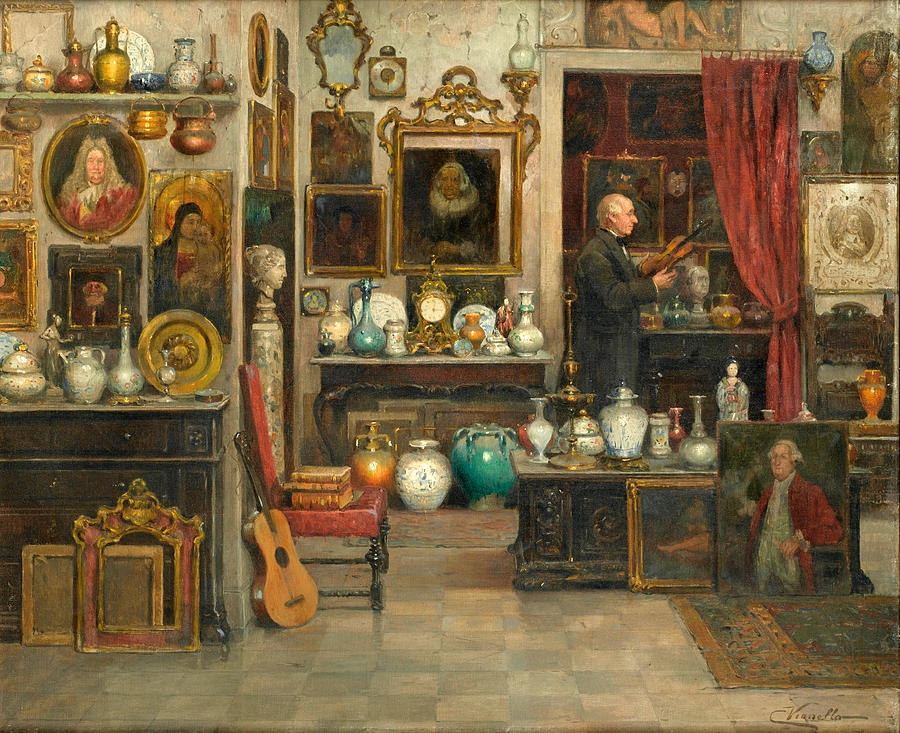
There is a fugitive obscenity coursing beneath the surface of contemporary life — a sickness not from deprivation but from surfeit, not from scarcity but from unmitigable dissipation. It is there in the landfill and the landfill’s cousin, the storage unit. It is there in the twitch of the index finger hovering over “Buy Now.” It is there in the garish fluorescence of the suburban big-box store; in a million mood boards, and “Amazon Find’ listicles, and “Must-Have” TikTok reels detailing the newest molded plastic gadget or designer dupe; in the unboxing videos watched by toddlers; in the tens of millions of square feet of new commercial warehousing erected to facilitate “same day” and “two day” shipping promises. We are dying not from what we lack but from what we have too much of.
Here is a thesis so simple it borders on heresy: We no longer need to manufacture much of anything.
The West — by which I mean the affluent consumer democracies of North America, Europe, and their global imitators — has, in the span of a single century, produced enough durable goods to clothe, house, furnish, and amuse every citizen for the rest of their natural life. Whether we speak of textiles, housewares, furniture, tools, books, toys, or art, there already exists an overabundance of objects sufficient to supply a well-appointed life to every person now living. That we continue to produce more is not just unnecessary, it is grotesque.
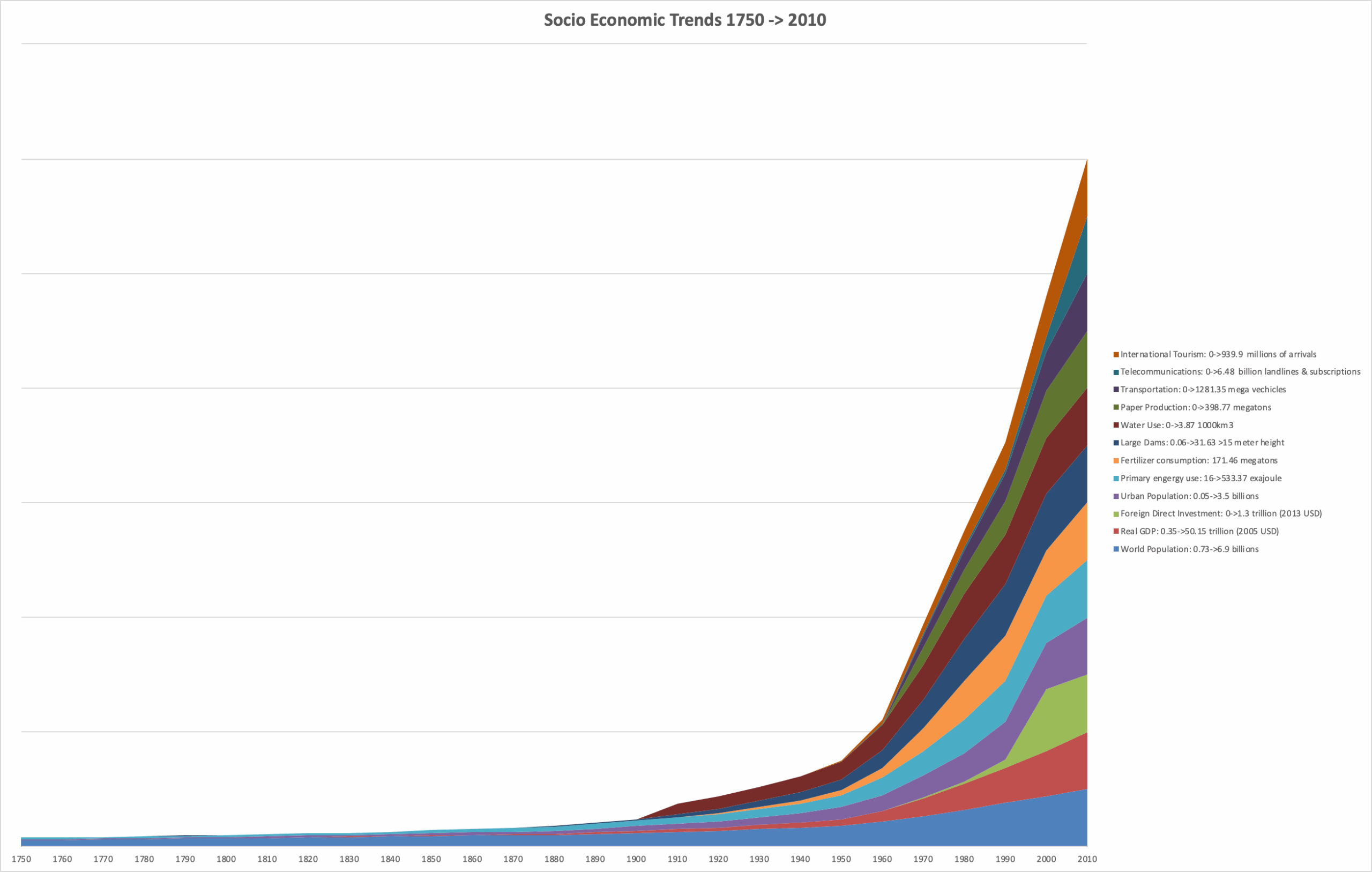
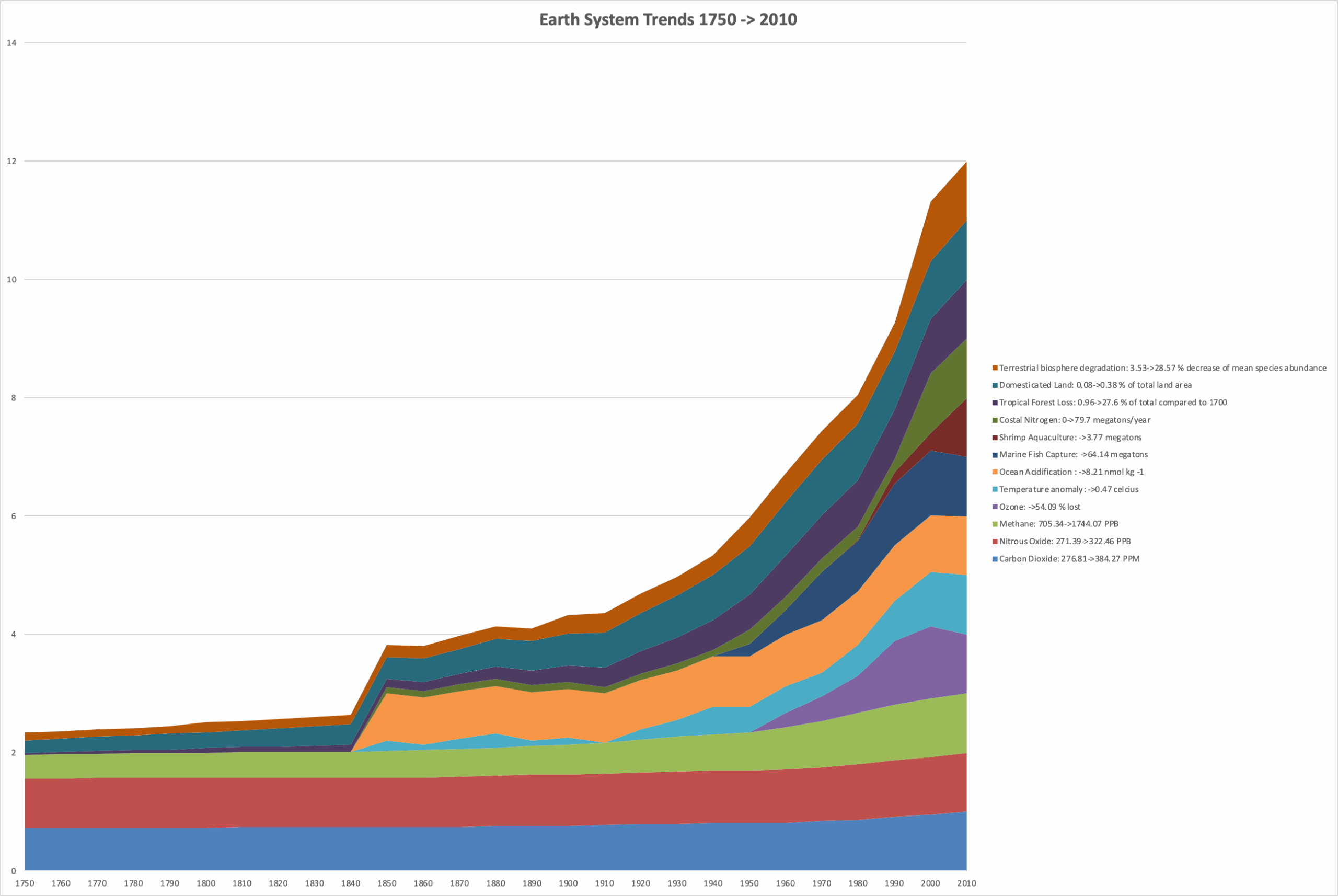
Let us situate this in time. After the Second World War, the industrial capacity of the United States — unscathed by bombing and flushed with capital — turned its war-making apparatus toward peace. Or rather, toward profit. This post-war surge of production, consumption, and suburbanization, often nostalgically remembered as prosperity, is what scientists and historians now call the Great Acceleration: the exponential rise, beginning around 1945, in everything from fossil fuel use to urban sprawl to plastic production to per capita GDP. Population increased, yes — but not as quickly as stuff. And the stuff came cheap. It was, for the first time in human history, possible for an ordinary person to possess dozens of pairs of shoes, a closet of coats, a home full of single-use appliances, a garage or shed full of tools, an attic of forgotten boxes of textbooks and magazines and unworn clothes and holiday décor.
That this felt like progress is not surprising. That it has now become a pathology should not be, either.
In 1960, the average American household generated 2.68 pounds of solid waste per person per day. Today, it is nearly five pounds. The global average is 1.6 pounds. The average clothing item in the West is worn seven times before being discarded. Appliances are no longer repaired for four decades — they are replaced every five years. This is not merely a cultural drift. It is a deliberate industrial strategy, well-known and named for three quarters of a century: planned obsolescence. First popularized by industrial designer Brooks Stevens in the 1950s, the idea was not to make things better or cheaper — but to make them expire. Cars with minute cosmetic redesigns each year. Radios with sealed backs. Clothing that begins to unravel and lose its shape after a single wash. It was — and remains — a system designed to sell the illusion of progress while quietly engineering decay.
And so we inhabit a civilization founded on rot. Not decay in the natural sense — organic, fertile, cyclical — but engineered degradation: the fraying seams, the cam-screw joint and particle board tear-out, the un-updateable firmware, the sealed batteries, the glue instead of removable fasteners, the printer that refuses to print because the disposable plastic cartridge is empty of its 8 milliliters of $1,500 a liter cyan ink.
This is not economics, it is moral betrayal.
We have inherited more than enough. There are homes across this country where entire toolsets — drills, saws, planes — made seventy years ago still function perfectly. I have worn wool coats from the 1940s warmer and more durable than anything sold at a department store today. I have eaten from century-old china, written with 19th-century pens, sharpened pre-war knives from Thiers that hold an edge better than any chromium steel alloy. The objects of the past were made to maintain with a minimum of fuss and to endure. The objects of the present are made to break and be unrepairable.
The fundamental philosophy of consumerism is this: that meaning is something you must continually buy to retain. It is the conviction that satisfaction expires. That desire must be kept perpetually inflamed. That a full life is not one marked by the care of objects, but by their continual replacement. This is not capitalism per se — it is a particular mutation of capitalism, swollen with credit, marketing, cheap energy, and global logistics.
And it is, in every serious sense, a philosophy of extinction.
It is no accident that consumerism metastasized precisely when the consequences of our material excess began to threaten the planetary systems that sustain us. Every plastic-wrapped novelty shipped halfway across the globe costs thrice its weight in carbon gas. Every article of fast fashion requires fossil-fueled machinery and transport, microplastic shedding polymer fibers and synthetic dyes washing into rivers. Every “smart” appliance demands rare earths mined by near-slaves, shipped to sit, unused in a cupboard, for 364 days of the year. The world is being choked not by necessities, but by cheap novelties. We do not make what we need, we make what we are told to want.
And we have been told, over and over and over to want far too much. We have been trained to believe that more must be bought, because why else earn money but to dispose of it?
Consumerism is not only wasteful — it is anxious, neurotic, and unstable. It demands the spoliation of contentment. A person satisfied with their possessions is a threat to the economy. So advertising and marketing — the quasi-aesthetic wing of industrial capitalism — trains us to want like addicts. Not to love the thing we have, but to itch for its successor. We no longer mend a thing when it breaks and replace it only when it becomes irreparable; we upgrade when the marketing department tells us our lifestyle is lagging.
Let us pause, then, and consider the obvious: What if we just… fucking stopped?
What if we simply refused to buy what we already possess in abundance? What if we learned again the quiet arts of repair, reuse, and restraint? Not out of miserliness, but of reverence? What if we saw in the bone china, the carbon steel pan, the hand-sewn quilt, the tufted wool rug, and the mortise-and-tenon jointed casework not just consumer objects — but anchors to material reality? What if, instead of bending our lives to accommodate the new, we shaped our lives to honor the existing? What if, instead of scrolling and scrolling and scrolling Amazon, and Temu, and Shein for new replacements we spent the time we would be shopping, mending things instead?
This would not be some primitivistic revaunch, it would simply bring to an end our long-coddled cultural adolescence… a return to civilizational adulthood.
We might become mature enough again to understand that “new” is not a synonym for “better,” that the past is not refuse for a landfill but assets for a library, and that our present abundance is not a sign to indulge, but an opportunity to repent of our ancestors’ overeager rapaciousness. The factory of the present should be an antique or thrift store, a repair shop, a tool library, a salvage yard, a sewing circle. A culture of care, not consumption. Of stewardship, not extraction.
We cannot solve ecological collapse with reusable tote bags, compostable straws and clamshells, and carbon offsets. We cannot avoid a mass extinction event by converting every attempt at resource and energy conservation into yet another consumer fad that accelerates the use of both. I am dead tired of the people who say that there is no ethical consumption under capitalism, when, in fact, it is entirely possible to just… not… fucking consume. No, there will never be a socioeconomic order in which you can have your cake and eat it. You will, in fact, have to stop. Waste less, own less, have fewer nonsensical conveniences. We cannot stave off any of these threats to the planet and ourselves with yet another remix of the same goddam thing restyled in some novel, greenwashed jargon…
However, we can, individually at least, begin to dismantle the culture that makes collapse and the end of human civilization inevitable. And that begins with saying: Enough.
Enough purposeless production. Enough unimaginative novelty for no sake but its own. Enough self-immolation disguised as progress and draped in the apparel of feckless, “self-actualizing” psychobabble.
We do not need more goods. We need to become good stewards of what we already have. Because we already have more than everything.